Heritage Day · 24 September 2026

Too Fly For These Haters

Rap out of Vosloorus about the flypast tradition born in 1995 — the same year as Heritage Day — carried forward in the language the township made.

Spotify, Apple Music & more · saved the moment it drops

Days
Hours
Minutes
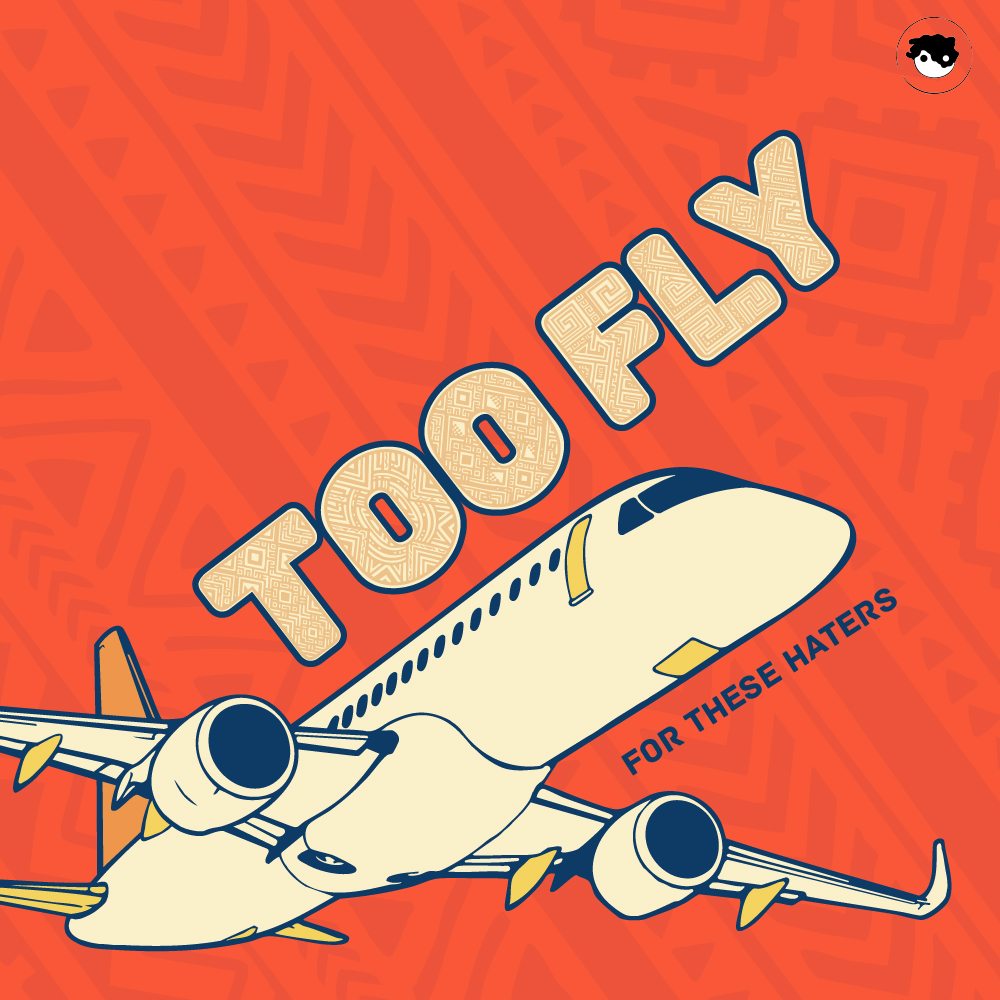
Too Fly For These Haters cover art: an illustrated jet climbing across a patterned orange ground

A tradition, not a stunt

When two jets crossed the sky, the internet had opinions. Most of them came from people who have never flown into this country. So the song checks the record instead of arguing with it.

The civil airliner flypast started in 1995 — the same year Heritage Day was first celebrated in democratic South Africa. Thirty-one years on, both are still here. That is living heritage: not a monument, but a practice, passed down and still in use.

The verses aren’t written in one language, because the township doesn’t speak in one. They touch on a vernacular unique to that crucible — people arriving from everywhere, and Sesotho, isiZulu, Afrikaans and English settling into a single way of speaking. Not verse by verse, but line by line, sometimes inside a single bar. That weave is the argument.

Released
24 Sept 2026
Produced by
EpikTheDawn
Engineered by
MixedByNipho
Label
Chasin’ Blaque
From
Vosloorus, Boksburg

Get the next one first

One email when there’s something worth hearing. No weekly anything.

You’re on the list.

Press

Writing about the release? Everything you need is here. Happy to share sources for the aviation claims in the verses.

Enquiries

Interviews, review copies, embargoed links.

statikblack@kayepi.pro

Assets

Cover art, alternate artwork, press photo.

Download press kit

Credits

Written and performed by Khwezi Mgoduka as Statik Black
Produced by EpikTheDawn
Engineered by MixedByNipho
Artwork designed by KayePi

Sources

Every factual claim in the verses is sourced and linked.

See the receipts

Receipts

Every factual claim in the verses, and where it comes from. The song runs in three movements — the rituals we keep, the people who practised them, and the numbers that justify the swagger — so the sources are grouped the same way.

On timing: the Cape Town flypast that prompted the song took place in August 2026, and the verses were written in the weeks that followed. The safety figures in the third verse were already public — SACAA announced them on 29 April 2026, and they were preliminary at the time, with the final detailed ICAO report expected within 90 days of that announcement.

Verse One

The rituals

The song opens by setting the table: how we carry ourselves, what we do with a loss, where the theatre comes from. Nothing is claimed yet — the character doing the claiming is being established first.

This is the home eyok’Spinna — we theatric if you catch my drift

Spinning is a South African motorsport that originated in Soweto in the late 1980s, first performed as a funeral ritual in which a car was spun to honour the dead. What sets it apart from drifting — which is Japanese in origin — is the theatre: drivers exit the car mid-spin to dance or hang from the windows while it keeps turning.

Verse Two

The pioneers

Those same rituals, put into practice at altitude. Here the flypast tradition and the people who built it are honoured the way this culture honours anyone — by naming them, and by telling what they actually did.

la mo tseba Laurie Kay

Captain Laurie Kay piloted the SAA Boeing 747-200 over Ellis Park at the Rugby World Cup final on 24 June 1995, with “GOOD LUCK BOKKE” across the underside of the wings. The aircraft made two passes, the second lower than the first, reportedly around 200 feet above the topmost seats. He died in April 2013 with over 23,000 flying hours logged.

First one to flyover the stadium in carriers

The 1995 Ellis Park pass is the origin of the South African civil airliner flypast tradition — a commercial passenger aircraft, near-empty but for its crew, rather than a military display.

carried on to flyover with choppers for the poachers

Kay suffered a fatal heart attack in April 2013 while volunteering his time in the fight against rhino poaching in the Kruger National Park.

Ever since his stunt with Don, Fourie, and Thomas

Kay was joined on the flight deck by Senior First Officer Billy Fourie, Senior Flight Engineer Don Coppard, and Senior Training Captain Selwyn Thomas, who was responsible for getting the time over target right.

Brought it to iDiski ne Cricket

Kay flew again over FNB Stadium for the 1996 Africa Cup of Nations, and SAA’s Ndizani Olympic tour followed that year, escorted on its display flight by four South African Air Force Mirage F1s. A three-aircraft SAA formation also passed over the Wanderers during the 2003 ICC Cricket World Cup.

Even the President’s in ’99 with three times the ride

Three SAA aircraft flew in formation over President Thabo Mbeki’s inauguration in June 1999. Kay led in a 747 Classic, with Scully Levine and Johnny Woods on either wing in 747-400s.

Verse Three

The numbers

The part that isn’t feeling. Having set out how we act and who we honour, the last verse answers why any of it is earned — with the record, not the mood.

Big body choices for the show when we plan it
Plus size — symbol for the people AND the Captain

Stadium flyovers elsewhere are military. South Africa is the country where the passenger airliner version became a tradition and kept going — from the 747 over Ellis Park in 1995, through the Africa Cup of Nations in 1996, Mbeki’s inauguration in 1999, the Cricket World Cup in 2003, a Harvard formation over Mandela Square in 2011, a FlySafair 737-800 over Ellis Park in 2022, the Emirates A380 in 2024, and the Airlink E190s over Cape Town in 2026. In 1995 it was considered almost unthinkable that something the size of a Boeing 747 would fly low and slow over a packed stadium.

nearly 40 years of airlines, no passenger has passed yet
Safest on the continent, 8th on the planet

SACAA announced a preliminary ICAO result of 95.12% on 29 April 2026, following an ICAO Coordinated Validation Mission, placing South Africa eighth globally and first in Africa — up from 91.23% at the 2023 full-scope audit. In the same release, Director of Civil Aviation Poppy Khoza cited the zero fatal accident rate the commercial airline sector has enjoyed for over four decades.